
I Can Hear You—But I Can’t Understand You: Why Speech Can Sound Unclear
“I can hear people. I just can’t understand what they’re saying.”
It’s a frustration we hear frequently in hearing care.
Maybe your spouse seems to mumble. Perhaps television dialogue isn’t as clear as it used to be. Or you do reasonably well talking with someone at home but have trouble following the same person in a busy restaurant.
That can lead to an understandable question:
If I can hear their voice, how can I have a hearing problem?
The answer is that detecting a sound and clearly understanding speech aren’t quite the same thing.
And sometimes, the earliest signs of a hearing change aren’t that the world becomes dramatically quieter.
Words simply become less clear.
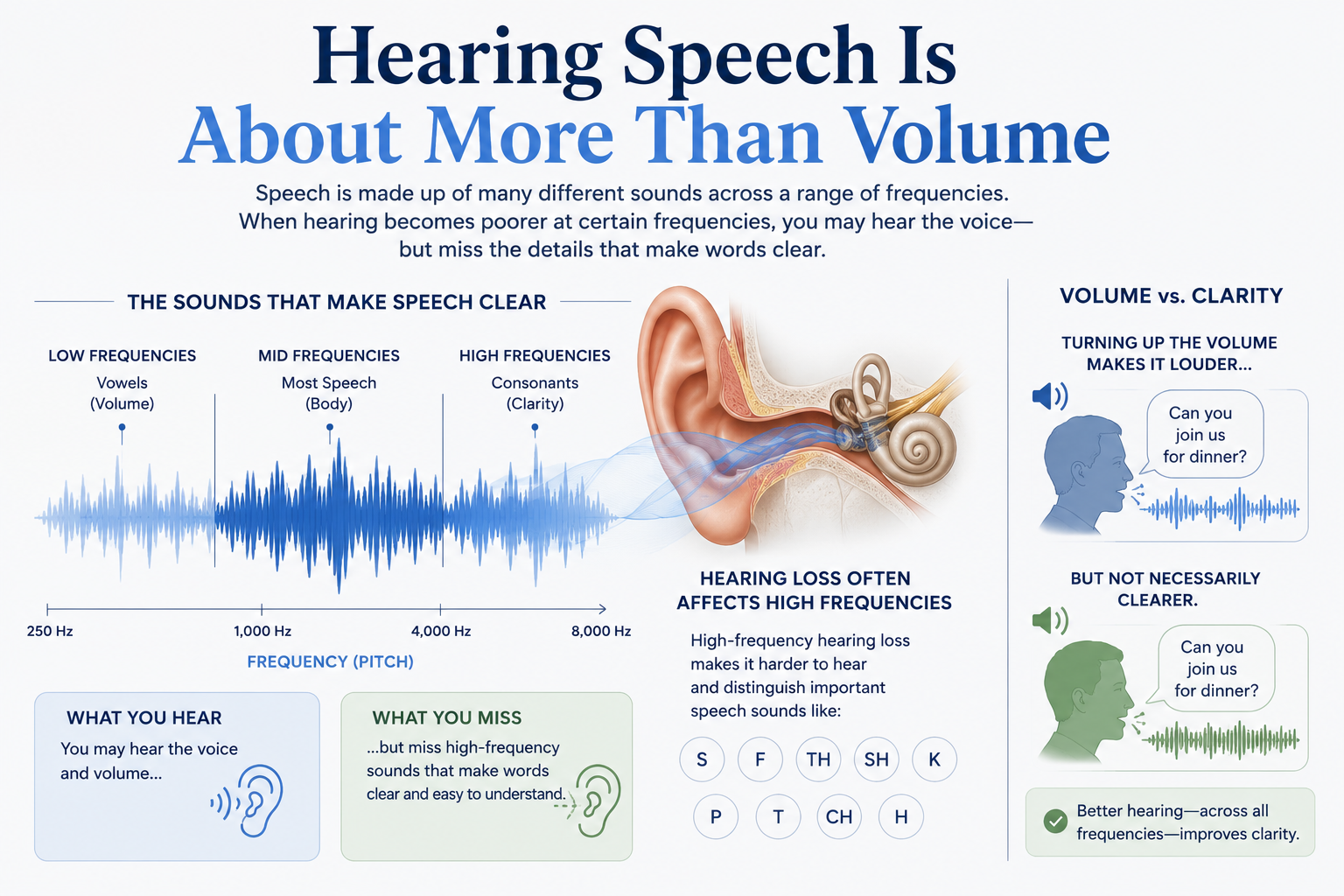
Speech is made up of many different sounds spread across different frequencies.
Some speech sounds carry a great deal of the clarity that helps us distinguish one word from another. When hearing becomes poorer at certain frequencies, you may still hear the louder portions of someone’s voice while missing some of the information necessary to identify exactly what was said.
The National Institute on Deafness and Other Communication Disorders (NIDCD) notes that noise-induced hearing loss can make speech sound muffled and can make high-frequency speech sounds, including some consonants, difficult to hear.
That’s why:
Making something louder isn’t necessarily the same as making it clearer.
You may know perfectly well that someone across the table said something—you simply didn’t catch all the words.
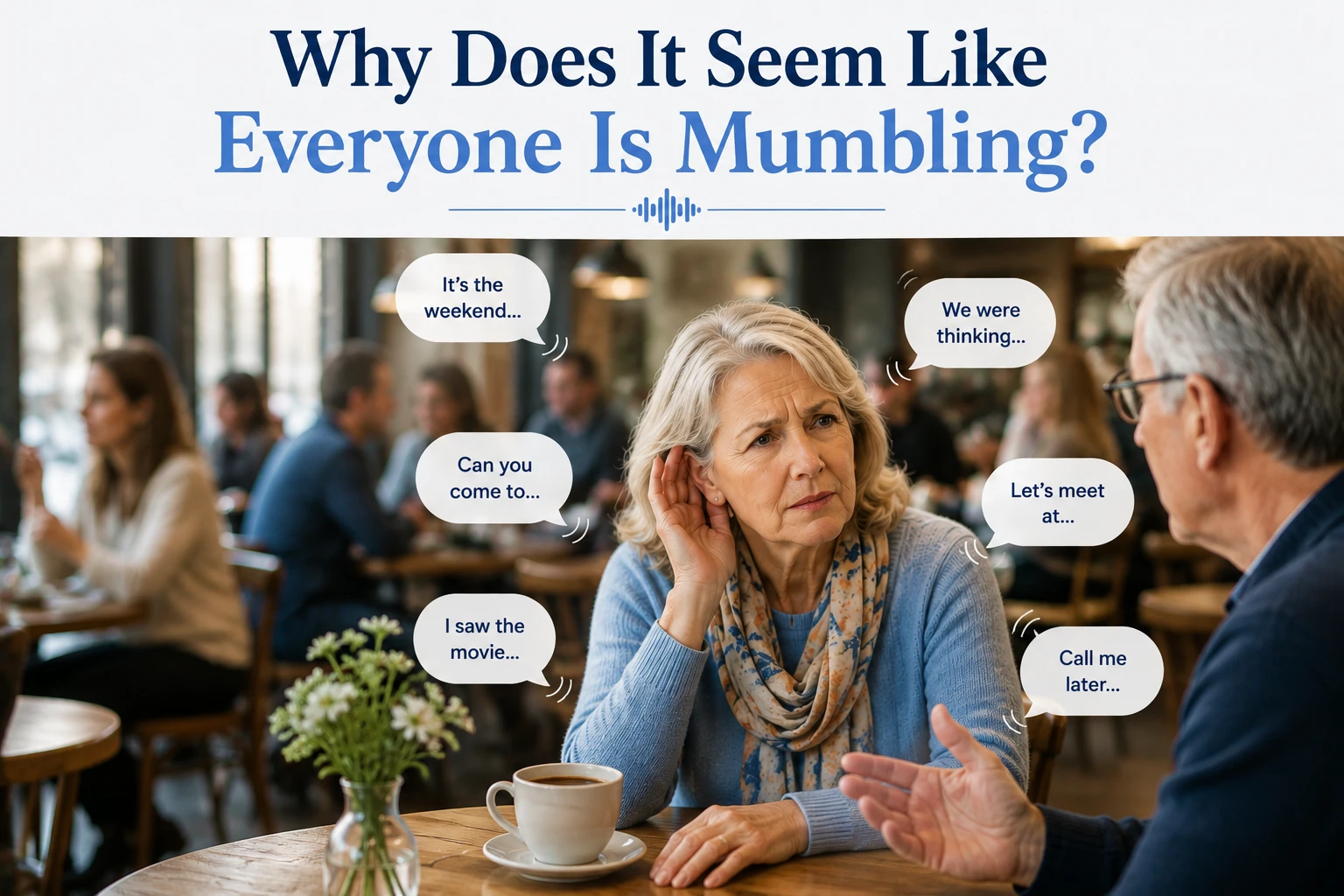
People sometimes compensate for unclear speech without realizing they’re doing it.
You might:
- Ask people to repeat themselves.
- Misunderstand one word for another.
- Turn up the television but still want captions.
- Hear better when you’re looking directly at the speaker.
- Understand one-on-one conversations better than group conversations.
- Do relatively well in quiet but struggle considerably in restaurants or other noisy places.
These experiences can occur with hearing loss, including age-related and noise-induced hearing loss. NIDCD notes that age-related hearing loss happens gradually, which can make the change difficult for people to recognize at first.
That’s important.
You don’t necessarily wake up one morning thinking, My hearing has changed.
Instead, you may gradually start thinking:
Why doesn’t anybody speak clearly anymore?
That’s another thing we hear.
And it illustrates why a professional hearing evaluation can provide information that simply turning up the television cannot.
A comprehensive hearing evaluation looks at more than whether you can hear something.
At Lawrence Hearing, our evaluation begins with a case history followed by audiometric testing. We then review the results with you and discuss appropriate next steps.
Speech testing is particularly relevant to this conversation. The American Speech-Language-Hearing Association explains that speech audiometry can evaluate both hearing sensitivity and speech-perception ability.
In other words, we’re interested not only in:
“Can you hear the sound?”
but also:
“How well are you understanding speech?”
Those aren’t identical questions.
A Hearing Test Gives Us a Starting Point
If you’ve noticed changes in speech clarity, the goal shouldn’t be to guess what’s causing them.
Get good information first.
A hearing evaluation can help determine whether hearing loss is present and provide information about the type and degree of hearing difficulty.
From there, recommendations should depend on your results and your individual needs.
At Lawrence Hearing, that’s an important distinction.
We don’t believe hearing care begins by choosing a hearing aid.
It begins by listening to you.
Where are you struggling?
At restaurants?
Watching television?
Talking with your spouse?
At church?
In meetings?
With your grandchildren?
Those details matter because two people can have different communication needs even when both are experiencing hearing difficulty.
Our approach is to combine test results with an understanding of the listening situations that matter in your everyday life.
Can Hearing Aids Make Speech Clearer?
When hearing aids are appropriate, their purpose isn’t simply to make everything louder.
Modern hearing aids are designed to provide amplification based on an individual’s hearing needs, and different devices and features may help in different listening situations.
But hearing aids also aren’t magic.
Your individual hearing loss, speech-understanding ability, listening environment, device fitting, and other factors can all influence the benefit you experience.
That’s one reason professional fitting and follow-up matter.
At Lawrence Hearing, an initial fitting is based on the individual’s audiogram and listening needs. Patients then experience their hearing aids in their actual everyday environments before returning for follow-up, where feedback can be used to make additional adjustments.
Real life is part of the process.
A hearing aid that sounds good in a quiet office still needs to work for your life.
Sometimes Better Communication Starts Before Technology
There are also practical changes families can make right now.
NIDCD recommends several communication strategies for people experiencing hearing difficulty, including facing the person while speaking, reducing competing background noise, speaking clearly rather than shouting, and being thoughtful about seating in noisy environments.
So at your next family dinner:
Turn down the television. Face each other. Get the person’s attention before beginning an important conversation. Move away from competing noise when possible.
Small changes to the listening environment can make communication easier.
When Should You Have Your Hearing Checked?
Consider scheduling a hearing evaluation if you’ve noticed that:
- People increasingly seem to mumble.
- You’re asking others to repeat themselves more often.
- Television dialogue is becoming difficult to follow.
- You hear someone speaking but frequently miss individual words.
- Conversations are noticeably harder in restaurants or groups.
- You understand people better when you can see their faces.
- Family members have started commenting on your hearing.
None of these signs by themselves tells us exactly what is happening.
That’s what the evaluation is for.
NIDCD similarly identifies frequently asking people to repeat themselves and increasing television volume among possible signs associated with hearing loss.
You Don’t Have to Guess What You’re Missing

One of the most frustrating things about gradual hearing changes is that you don’t know what you didn’t hear.
Sometimes it’s a consonant.
Sometimes it’s a punchline.
Sometimes it’s a quiet comment from your spouse across the table.
And sometimes you simply realize that following conversations requires more effort than it once did.
If you’ve caught yourself saying:
“I can hear you. I just can’t understand you.”
it’s worth finding out why.
At Lawrence Hearing, our family-owned practice has more than 20 years of experience helping people throughout the Hudson Valley understand their hearing and find solutions tailored to their individual needs.
Start With a Conversation
A hearing evaluation can give you a clearer picture of what you’re hearing, what you may be missing, and what options are appropriate for you.
Schedule your FREE hearing consultation with Lawrence Hearing.
📞 (845) 343-7708 | Middletown & Warwick, NY
Local care. Smarter sound. Come hear the difference.